

January In Print: TEG and ROTEM in bleeding patients with coagulopathy- EAST Guidelines

The Eastern Association for the Surgery of Trauma (EAST) guidelines are well regarded as a trusted source of evidence-based medicine. It was therefore with much interest that I noted this latest edition to their extensive list. As thromboelastography (TEG) and rotational thromboelastometry (ROTEM) become more widely available it is prudent to reflect on the strength of the evidence behind this point of care technique. In contrast to traditional methods of assessment of coagulation, TEG and ROTEM assess viscoelastic clot strength in real-time as well as quantifying the timing and extent of fibrinolysis, something which is considered more appropriate for the resuscitation of the bleeding trauma patient and thought to limit need for transfusion and potentially improve mortality.
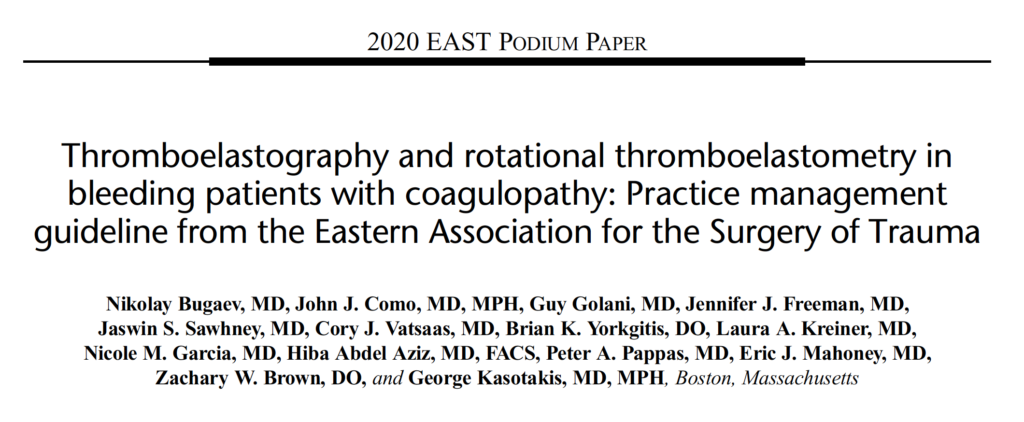
The paper authored by Nikolay Bugaev and colleagues on behalf of the EAST Working Group, has utilised established methodology for clinical practice guidelines. PRISMA (Preferred Reporting for Systematic Reviews and Meta-Analyses) and GRADE (Grading of Recommendations, Assessment, Development and Evaluations). The initial literature review included publications from January 1946 through to June 2020 with the final 7 studies included in the meta-analysis concerned with adult trauma patients being published between 2011 and 2019.
There were three Population, Intervention, Comparison, Outcomes (PICO) questions developed. Only one related specifically to adult trauma patients though and is the subject of this review: (PICO 1) In adult trauma patients with ongoing haemorrhage and concern for coagulopathy (P), should TEG/ROTEM-guided transfusion strategy (I) versus a non-TEG/ROTEM-guided transfusion strategy (C) be used to reduced mortality, blood product transfusions, and the need for additional haemostatic (angioembolic, endoscopic or surgical) interventions (O)?
The EAST Working Group considered the following outcomes as critical:
- Transfusion of packed red blood cells (PRBC) plasma and fresh frozen plasma, (FFP), platelet concentrate (PLT), cryoprecipiate (Cryo), fibrinogen and prothrombin complex concentrate (PCC).
- Need for additional haemostatic intervention (embolic, endoscopic, surgical)
- Time to bleeding control.
- Mortality (first 24 hours and in hospital)
While all of these outcomes were included in the study design, not all were reported in each study. In fact, time to bleeding control was not reported in any of the studies.
Of the 38 studies included in the final analysis, 7 were selected to address the trauma-specific PICO question above. This equated to 481 patients in the intervention group (TEG/ROTEM-guided transfusion) and 1,224 patients in the control group (non-TEG/ROTEM-guided transfusion). The actual use of TEG or ROTEM was variable, based on local guidelines. ROTEM was used in 5 studies and TEG in 2. (The paper actually describes TEG as only being used in one study however review of the relevant papers revealed that it was used by both Gonzalez et al[1] and Unruh et al[2]). Six of the 7 studies involved civilian and one involved military patients.[3] One of the 7 studies involved burn patients only.[4]
All 7 studies examined the use of PRBC, PLT and FFP. Only 3 studies included Cryo [1-3] 3 studies included fibrinogen[4-6] and 2 studies included PCC [5-6]. All apart from one of the studies examined mortality[4]. Only Unruh et al examined the need for intervention for haemostasis[2].
Qualitative analysis was initially performed. The authors report that one study was able to demonstrate an improvement in mortality[1] with the remaining 5 studies showing no difference. The authors also found an inconsistent effect on blood product use across the 7 studies, with either no-effect or decreased use of PRBC, PLT, FFP, or Cryo. One study showed an increased use of fibrinogen associated with TEG/ROTEM[1]. None of the studies examined the effect of TEG/ROTEM on the need for surgical or interventional radiology haemostasis.
All studies were deemed suitable for inclusion in the quantitative analysis. On combining all patients in a meta-analysis, a beneficial effect from TEG/ROTEM was demonstrated for:
- Number of patients transfused with PRBC. RR 0.74 (95%CI 0.67-0.82). Absolute effect (AE) 21 patients fewer per 1,000 (95%CI 319-174 fewer)
- Number of patients transfused with PLT. RR 0.35 (95%CI0.22-0.55). AE 289 patients fewer per 1,000 (95%CI 346-200 fewer)
- Number of transfused units PRBC per patient. SMD -0.38. (95%CI -0.64—0.12)
- Mortality. RR 0.75 (95%CI 0.59-0.95). AE 38 patients fewer per 1,000 (95%CI 62-8 fewer)
There was no beneficial effect on the number of transfused units of FFP. It does not appear that the meta-analysis included an assessment of the use of Cryo, fibrinogen or PCC.
Of particular significance was the grading of evidence. Due to the observational nature of all studies, the inconsistent effect on blood product transfusions and the low numbers of patients in most studies (ranging from 30 to 681) with wide confidence intervals, the level of evidence was assessed as very low.
Despite the obvious limitations of the present meta-analysis due to the very low level of evidence, the authors have conditionally recommended using TEG or ROTEM-guided transfusion strategy over a non-TEG or ROTEM -guided strategy, for adult trauma patients with ongoing haemorrhage and concern for coagulopathy to reduce blood product transfusions and mortality.
The authors justify this conclusion based on the potential benefits (fewer patients exposed to blood product transfusion and less mortality) along with an apparent lack of harm associated with using TEG or ROTEM. Appropriately, there has been no mention of need for additional haemostatic mechanisms.
So, will these EAST guidelines change your clinical practice? It is clear that the evidence is at best, weak. In the absence of evidence of any harm the potential benefits may be enough, however. Would a cost analysis make a difference? Any such analysis would need to be conducted at a local (Australian and New Zealand) level, in order to be applicable.
In conclusion, the new EAST Guidelines for the use of TEG and ROTEM in bleeding patients with coagulopathy (or at least a concern for coagulopathy as outlined in the PICO question) probably go a little way towards justifying the use of this point of care assessment of coagulation and fibrinolysis in adult trauma patients, though the evidence is weak. What is clear is that more high-quality research is required.
References:
[1] Gonzalez et al 2016. Ann Surg. 263(6):1051-1059
[2] Unruh et al 2019. Am J Surg. 218:1175-1180
[3] Prat et al 2017. J Trauma Acute Care Surg. 83(3): 373-380
[4] Schaden et al 2012. B J Anaes. 109(3):376-381
[5] Guth et al 2019. Anaes Crit Care Pain Med. 38:469-476
[6] Schochl et al 2011. Critical Care. 15:R83.
[7] Nardi et al 2015. Critical Care. 19:83.